Huang Yuxing
Introduction
Huang Yuxing, born in 1975 in Beijing, is a distinctive and influential contemporary Chinese artist known for his exceptional ability to weave colors, brushstrokes, and the traces of his creative process into his captivating canvases. His work transcends traditional boundaries, drawing inspiration from natural elements, human experiences, and complex emotions to create pieces that are as thought-provoking as they are visually stunning. Demonstrating a harmonious blend of traditional and modern techniques, Huang’s art reflects his dedication to exploring and preserving the process of creation itself, embodying a vibrant and self-sufficient life of its own.
Early Life and Education
Huang Yuxing was born in Beijing, China, in 1975. From a young age, he demonstrated a profound interest in art, influenced by his surroundings and the rich cultural heritage of his homeland.
Pursuing his passion for painting, Huang attended the prestigious Central Academy of Fine Arts in Beijing, where he specialized in Mural Painting. He graduated in 2000 with a comprehensive understanding of traditional Chinese art techniques, which he later integrated into his contemporary works. Huang's education laid a solid foundation for his artistic exploration, allowing him to develop a unique style that combines the meticulous brushwork of Gongbi Zhongcai with a vibrant modern aesthetic.
Artistic Career
Huang Yuxing's artistic career is marked by a constant evolution of style and technique, reflecting his commitment to exploring new creative dimensions.
Initial Works
In the early stages of his career, Huang focused on developing his unique style, characterized by an expressive use of color and dynamic compositions. His initial works showcased his ability to blend traditional Chinese painting techniques with contemporary influences. As he progressed, Huang's art began to reflect a deeper exploration of landscape and human form, creating a striking contrast between vivid colors and the realities of life. This period was crucial in establishing Huang’s reputation as an innovative artist capable of pushing the boundaries of conventional art forms.
Major Exhibitions
Huang Yuxing has been consistently recognized for his exceptional talent, with his works featured in numerous solo exhibitions worldwide. Some notable exhibitions include "The Lake of Barking Infants" at Whitestone Gallery in Tokyo in 2019 and "Kingdom of Gold" at Whitestone Gallery in Taipei in 2018. In 2016, his exhibition titled "AND NE FORHTEDON NÁ" was showcased at Galerie Perrotin in Hong Kong. Huang's decade-long retrospective, "Alluvial Huang Yuxing 2005–2015," was held at the Minsheng Modern Art Museum in Shanghai in 2015, alongside "Liquidus" at the YUZ Museum. His exhibitions have been well-received, enhancing his global presence and acclaim in the art world.
Influences and Style
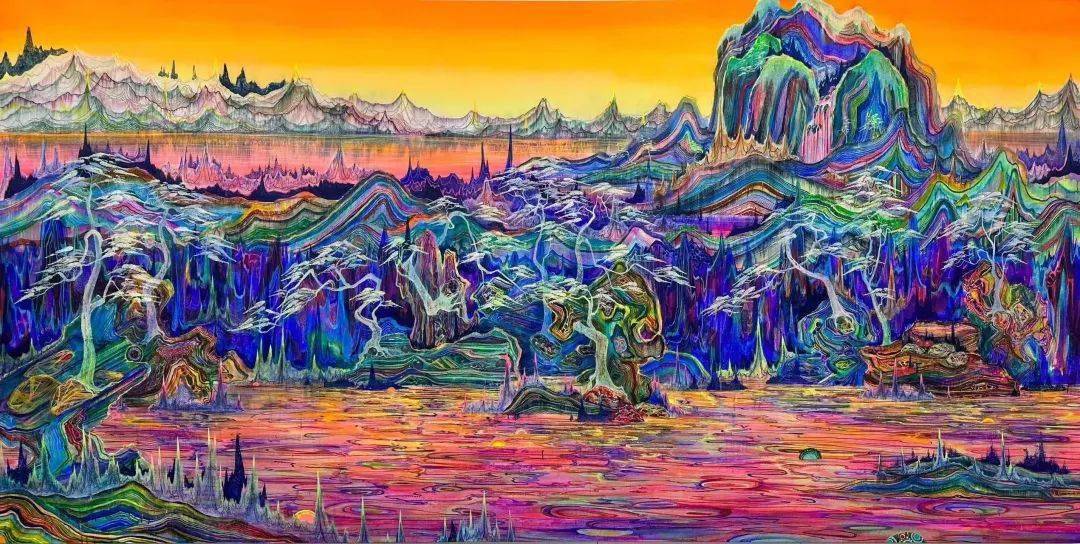
Huang's work is deeply influenced by elements of nature such as water, whirlpools, forests, minerals, crystals, and architecture. Rather than striving for a literal representation, he seeks to capture the essence and impression these elements evoke. His approach involves a meticulous process of layering and blending colors, creating a dynamic energy that resonates with viewers. Huang’s style is a testament to his mastery of color theory and composition, drawing viewers into a contemplative experience akin to losing oneself in the flow of a river. His dedication to refining his technique ensures that each painting pulsates with life, serving as a catalyst for ongoing creative exploration.
Huang Yuxing's portfolio includes a range of notable works that embody his distinctive style and thematic interests. His paintings often feature recurring motifs such as rivers, bubbles, treasures, sunrises, and sunsets. These elements are rendered with dazzling visual effects, showcasing his extensive study of individuals, nature, and the broader spectrum of life. Huang’s ability to juxtapose the vibrancy of color with the complexities of human existence is evident in each piece, offering viewers an immersive and reflective experience. His works not only capture the aesthetic beauty of the world but also invite contemplation on the deeper philosophical questions of existence.








